888-450-3725
In this article
How to measure packaging dimensions correctly: step-by-step measuring for boxes, tubes, and irregular shapes plus pad-space rules so the item always fits. At Discount Box Printing, we make custom packaging boxes to any size, factory-direct across the United States. This guide covers sizes, tips, and cost points so you pick right the first time.
How do I measure packaging dimensions?
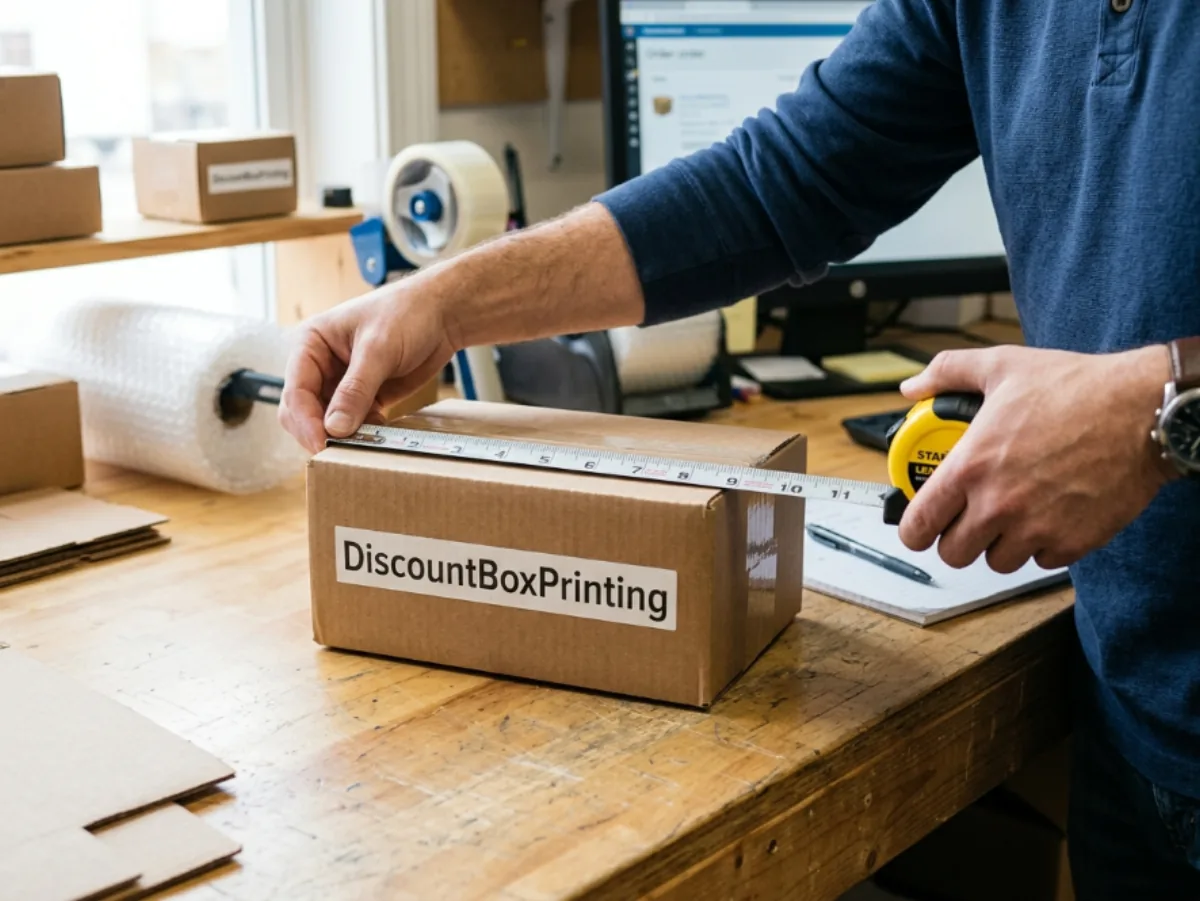
To measure a box, lay it flat with the opening face up. Measure the long edge for length, the short edge for width, and the depth for height. Read L × W × H. Use inside sizes so the item fits with pad space. At Discount Box Printing we make any size factory-direct from $0.10 per unit. Beat any box quote.
- Tool: tape measure or steel ruler
- Unit: inches (US) or mm (EU)
- Order: Length × Width × Height
- Inside sizes: for fit
- Outside sizes: for shipping and dim
- Retail pad: 1/8 in per side
- Shipping pad: 1/4–1 in per side
- Round up: to next 1/2 in
The Right Way to Read a Box
Every box has three numbers in one order: Length by Width by Height. Length is the long edge of the opening. Width is the short edge of the opening. Height is the depth from base to top when the box sits with the opening face up. So 8 × 6 × 2 is 8 long, 6 wide, 2 deep.
This order is fixed across all packaging suppliers in the US and EU. Never flip length and width. Never call depth height on a tall box — height is always the third number.
Measuring an Existing Box
Set the box on a flat surface with the opening face up. Take a tape measure. Read the long edge of the opening. That is length. Read the short edge of the opening. That is width. Read the depth from the base to the top. That is height. Write the three numbers.
Measure inside for folding cartons and mailers. Measure outside for rigid boxes with 2 to 3 mm thick walls, since inside and outside can differ by 1/2 in.
Measuring Your Product Correctly
Lay the item on a flat surface. Measure length at the longest point. Measure width at the widest point (perpendicular to length). Measure height at the tallest point. For odd shapes, use the tightest bounding box that fully contains the item.
For a curved bottle or jar, measure to the outer edges of the curve, not the label. The box has to fit the widest part of the shape, not the average.
Adding the Right Pad Space
Add 1/8 in per side for a snug retail carton with no rattle. Add 1/4 in per side for a shipping box with a paper wrap. Add 1 in per side for a shipping box with a full air-pillow pad or foam insert. Always round up to the next 1/2 in for clean spec.
Inside vs Outside Dimensions
Inside dimensions are the space the item sits in. Outside dimensions are the box wall to wall. Folding cartons differ by 1/16 in. Corrugated cartons can differ by 1/4 in per side. Rigid boxes differ by 1/2 in. Order by inside dims so the product always fits.
Measuring Tubes and Cylinders
For a tube or cylinder, measure the diameter across the widest point plus 1/8 in each side for the box opening. Measure the tube length plus 1/4 in for the box depth. So a 1 by 5 in tube fits a 1.25 by 1.25 by 5.25 in carton.
Common Measuring Mistakes to Avoid
Flipping length and width. Calling depth height on a tall box — height is always the third number. Measuring outside dims when the sheet asks for inside. Skipping the pad space. Rounding down and finding out the product does not fit.
Sizes & Dimensions Chart
Pad-space rules by SKU type — add these to the product size to spec the box.
| Use case | Popular Size (L × W × H) | Best Fit |
|---|---|---|
| Small e-com item | Product + 1/4 in per side | Roll-end mailer |
| Retail shelf good | Product + 1/8 in per side | Reverse tuck carton |
| Fragile shipping | Product + 1 in per side | Corrugated shipper |
| Cosmetic jar | Jar + 1/8 in per side | Reverse tuck carton |
| Tube or bottle | Diameter + 1/8, length + 1/4 | Tall tuck carton |
| Odd-shape item | Tightest bounding box | Custom rigid or foam |
| Multi-item kit | Total + 1/4 in + insert | Two-piece rigid |
Wholesale Cost and Ordering
Custom sizes cost the same as stock sizes in bulk. So there is no reason to force an item into a poor fit. We make the boxes ourselves, which means no reseller markup and no setup fee. Low MOQs let you test a size before you scale. Send a rival quote through Beat My Quote and we will try to come in lower.
- Request a free quote. Share the size, the style, the print, and the count.
- Get a free proof. Our team preps a dieline and a 3D mockup at no cost.
- Approve and we print. We build factory-direct after sign-off.
- Free US delivery. Your boxes ship to your door in 10 to 12 days.
Explore More
- Product Packaging Dimensions — beginner guide.
- Custom Packaging Box Dimensions — pick the fit.
- Standard Packaging Box Dimensions — by industry.
- Packaging Dimensions Calculator — sizing tool.
- Free Sample Kit — test fit before you print.
Frequently Asked Questions
How do I measure box dimensions correctly?
Lay the box flat with the opening face up. Measure the long edge of the opening for length. Measure the short edge of the opening for width. Measure the depth from base to top for height. Read as L by W by H.
Should I use inside or outside dimensions?
Order by inside dimensions so the product always fits. Outside dims are for shipping and dim-weight math. Folding cartons differ by 1/16 in, corrugated by 1/4 in per side, and rigid boxes by 1/2 in per side.
How much pad space should I add to the product size?
Add 1/8 inch per side for a snug retail carton. Add 1/4 inch per side for a shipping box with paper wrap. Add 1 inch per side for a shipping box with air pillow or foam. Round up to the next 1/2 inch.
How do I measure an irregular product?
Use the tightest bounding box that fully contains the item. Measure length at the longest point, width at the widest perpendicular to length, and height at the tallest. For curved shapes, measure to the outer edge of the curve.
What order do box dimensions go in?
Length by Width by Height (L x W x H). Length is always the long edge of the opening. Width is the short edge of the opening. Height is the depth. This order is fixed across all packaging suppliers.
What tool should I use to measure packaging?
A steel ruler is best for boxes under 12 inches for accuracy. A tape measure works for larger boxes. A digital caliper gives the most accurate reading for cosmetic and jewelry items where 1/32 in matters.
What price can I expect for custom how to measure packaging dimensions in bulk?
Wholesale custom how to measure packaging dimensions start from about $0.10 per unit at Discount Box Printing, with the final price set by size, board thickness, print color count, and run size. Larger orders cut the per-unit cost by a wide margin, and you can send a competing quote to our <a href="/beat-my-quote">Beat My Quote</a> page to lock in a better rate.
What is the minimum order quantity for custom how to measure packaging dimensions?
We print custom how to measure packaging dimensions with a low minimum order so small brands and new product lines can start without a big spend. Low MOQs let you test art and sizes on the shelf before you scale up, and when you reorder in bulk the per-unit price drops. Reach out for the exact MOQ on your spec.
How long does it take to print and deliver custom how to measure packaging dimensions?
Standard turnaround on custom how to measure packaging dimensions is about 10 to 12 business days after proof approval, with a 6 to 8 day rush option on most jobs. Timing starts once art and dieline are signed off, so a fast proof reply keeps the clock short. Free US ground shipping is included on every order.
Do you offer free design, a dieline, and a 3D mockup for custom how to measure packaging dimensions?
Yes. Every custom how to measure packaging dimensions order at Discount Box Printing includes free design help, a print-ready dieline, and a 3D mockup before we go to press. Our team cleans up logos, sets bleeds, and checks food-safe inks when needed, so the box you approve on screen is the box you receive at your door.
Do you ship custom how to measure packaging dimensions across the United States?
Yes. We make custom how to measure packaging dimensions factory-direct and ship to every state in the US with free ground freight on wholesale orders. Our team at Discount Box Printing coordinates print, cut, and dispatch under one roof, so your boxes land on time whether you order from New York, Texas, California, or anywhere between.
Ready to order your custom boxes?
Free design, low minimums, fast turnaround — at wholesale prices.
Get a Free Quote
Related Posts
Die-Cut Box Dimensions: Sizes & Custom Shapes Guide