888-450-3725
In this article
- What are custom eco-friendly boxes?
- What Are Custom Eco-Friendly Boxes?
- Why Sustainable Packaging Matters Now
- Recyclable vs Biodegradable vs Compostable
- Sustainable Materials and Boards
- Eco-Friendly Box Styles and Types
- Sizes and Right-Sizing to Cut Waste
- Printing and Eco Finishes
- Eco-Friendly Boxes for Every Industry
- Certifications and Avoiding Greenwashing
- Wholesale Custom Eco-Friendly Boxes: Cost and Minimums
- How to Order Custom Eco-Friendly Boxes
- Final Thoughts
Green packing is no longer a nice-to-have. It is a buying factor. Shoppers read the box before the label. A recycled kraft carton signals values in a way plastic cannot. But "eco-friendly" is a crowded word. Not every green-looking box is truly green. At Discount Box Printing, we make custom eco-friendly boxes factory-direct. We ship to brands across the US. This guide breaks down what makes a box green. It shows the real gap between recycled, biodegradable, and compostable. It walks you through which stocks and finishes to pick. And it shows how to order at true wholesale prices with no fake green claims.
What are custom eco-friendly boxes?
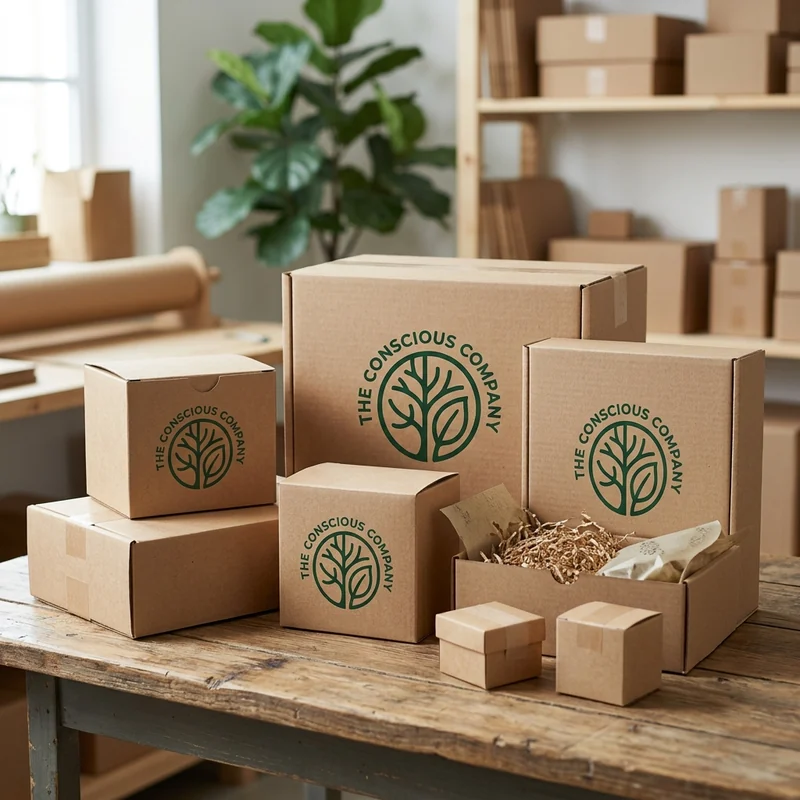
Custom eco-friendly boxes are packaging made from recycled kraft, FSC-certified paperboard, or plant-fiber corrugated, printed with soy-based inks and finished with water-based coatings — curbside recyclable, plastic-free, and often compostable. At Discount Box Printing we make eco boxes factory-direct from $0.10 per unit. Beat any eco-box quote.
- Best for: sustainable DTC, organic beauty, food, refill programs
- Material: recycled kraft, FSC SBS, plant-fiber corrugated
- Inks: soy-based, water-based coatings, PMS or CMYK
- End of life: curbside recyclable; compostable options available
- Certifications: FSC, SFI, PEFC on request
- Turnaround: 10–12 business days (rush 6–8 available)
- Price from: $0.10 per unit wholesale · free US shipping
- Made in: USA, factory-direct — ships nationwide
What Are Custom Eco-Friendly Boxes?
Custom eco-friendly boxes are packs made from recycled or plant-based stock. They print with low-impact inks. They are built to your size and brand. Then they break down or get recycled at the end of their life. The goal is simple: protect the product, carry the brand, and leave a smaller footprint. Most use kraft, recycled board, or recycled corrugated. They skip plastic and foil layers that are hard to recycle.
The "custom" part matters as much as the "eco" part. A box cut to fit your product uses less stock and less fill. That lowers both cost and waste. So a good green box is often the tight box too, not just the greener one.
Why Sustainable Packaging Matters Now
Three forces push brands toward greener boxes. First, buyers now pick and pay more for brands that pack in green ways. Second, stores and online sites now set pack rules that vendors must meet. Third, plastic rules are spreading. Many states now charge fees for non-recycled packs. That cost keeps rising. Paper boxes sit on the right side of all three trends. For more on these shifts, Packaging World is a trusted US source for pack news and green data.
Recyclable vs Biodegradable vs Compostable
These three words are not the same. Using the wrong one is the most common green-claim mistake. Here is the plain-language difference:
- Recycled — the stock can be picked up and turned into new goods. Clean kraft and corrugated can be recycled curbside across the US.
- Biodegradable — the stock breaks down on its own, but with no set time or place. It is the loosest term, so use it carefully.
- Compostable — the stock breaks down into safe matter in a set place and time. Look for a tested mark. Note if it needs a home or trade compost site.
For most brands, recycled paper packs are the safest claim. The recycling stream is set up in every state. Compostable fits food-contact items. Biodegradable is best skipped as a claim on its own.
Sustainable Materials and Boards
The board you pick sets how green the box is. The common sustainable options are:
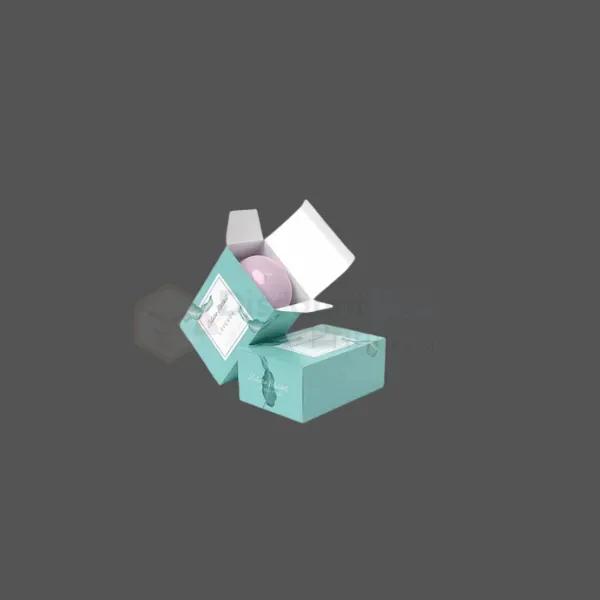
- Recycled kraft board — plain brown stock that shows its fiber. The classic eco look for product and soap boxes.
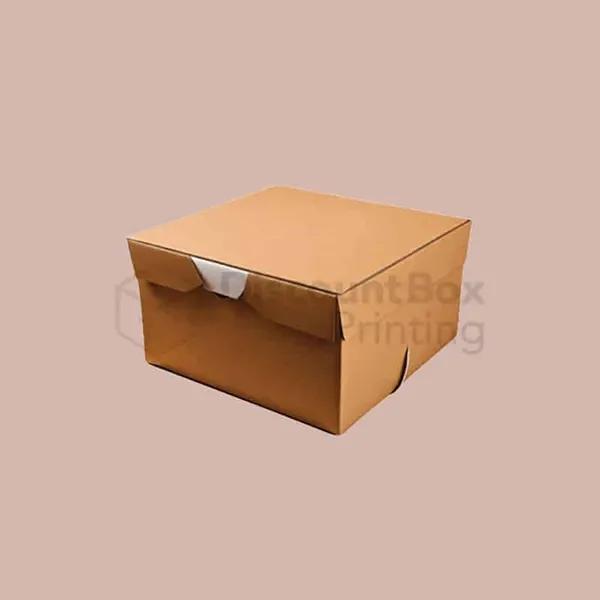
- Recycled corrugated — strong fluted board for shipping boxes and mailers, made from recycled fiber.
- FSC-tested board — new fiber from well-run forests, for a clean white print surface.
- Bare and lightly coated stocks — easier to recycle than plastic or foil layers.
Pair these with water- and soy-based inks. Skip plastic film windows and glossy coats when you can. Those coats are what push a paper box out of the recycling stream.
Eco-Friendly Box Styles and Types
Green packs come in every shape you use now. Going green rarely means changing your line. The styles we print most often include:
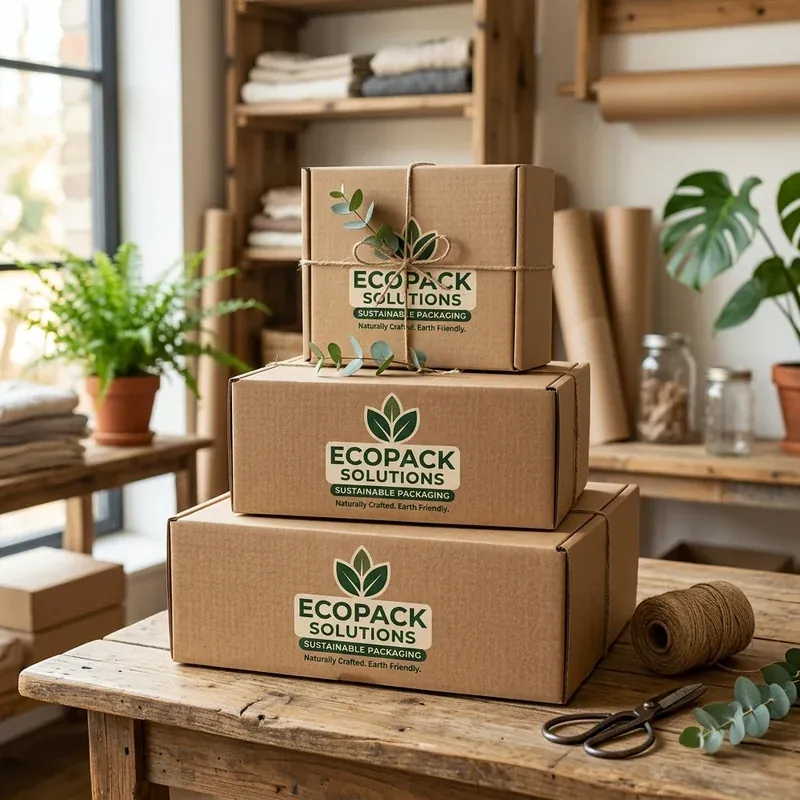
- Custom eco-friendly boxes with your logo — kraft tuck-end boxes that shoppers read as eco at once.
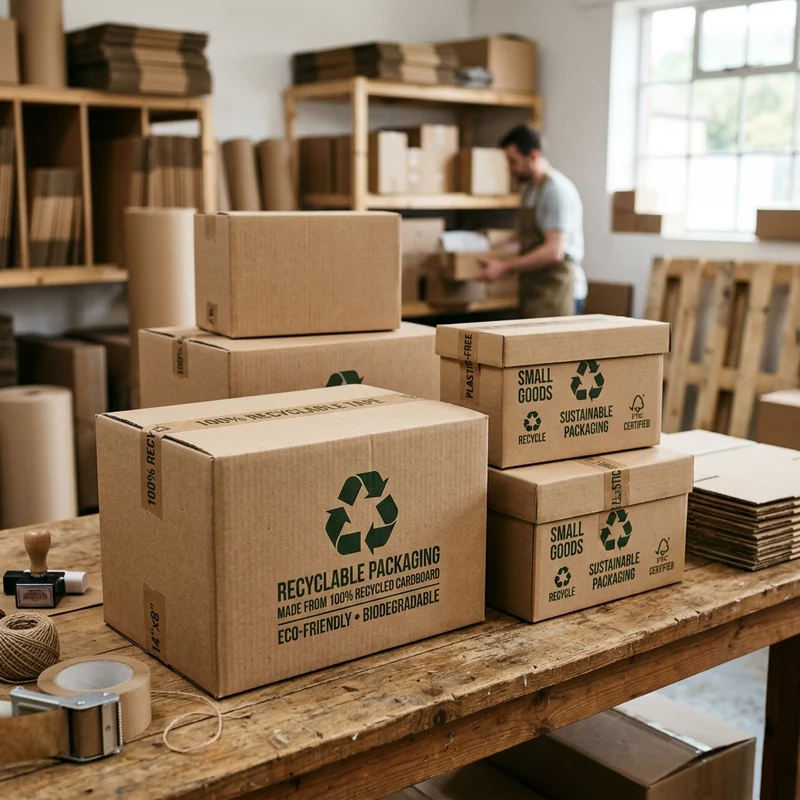
- Recyclable packaging boxes — paper cartons made for curbside bins.
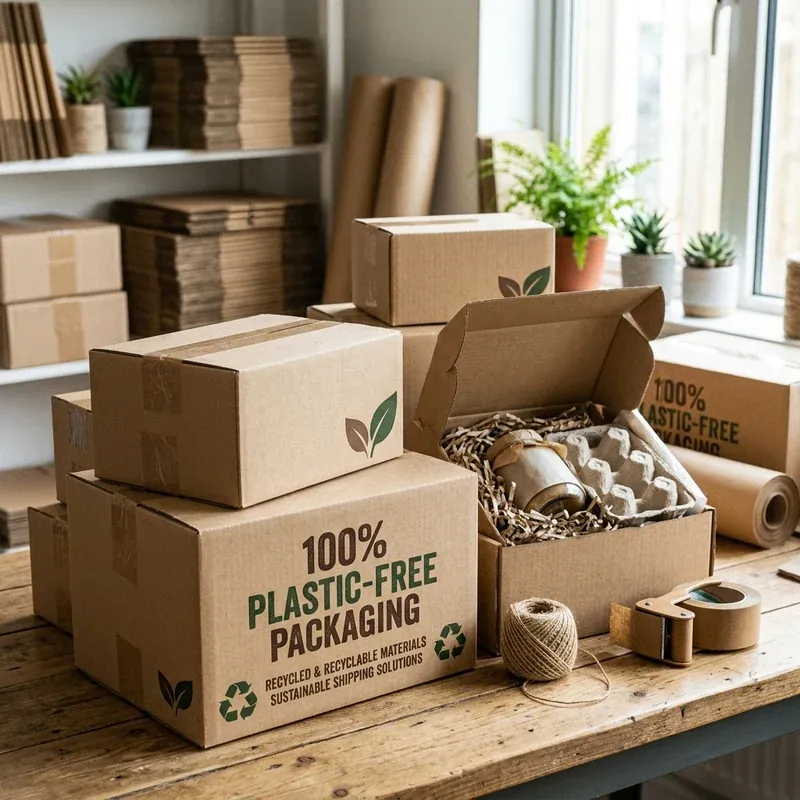
- Plastic-free packaging boxes — paper-only construction with no film or foil.
- Wholesale kraft packaging boxes — the plain-brown pick at bulk pricing.
- Compostable product packaging — tested picks for food and short-life items.
- Sustainable wholesale boxes — recycled mailers, retail, and monthly boxes at scale.
Sizes and Right-Sizing to Cut Waste
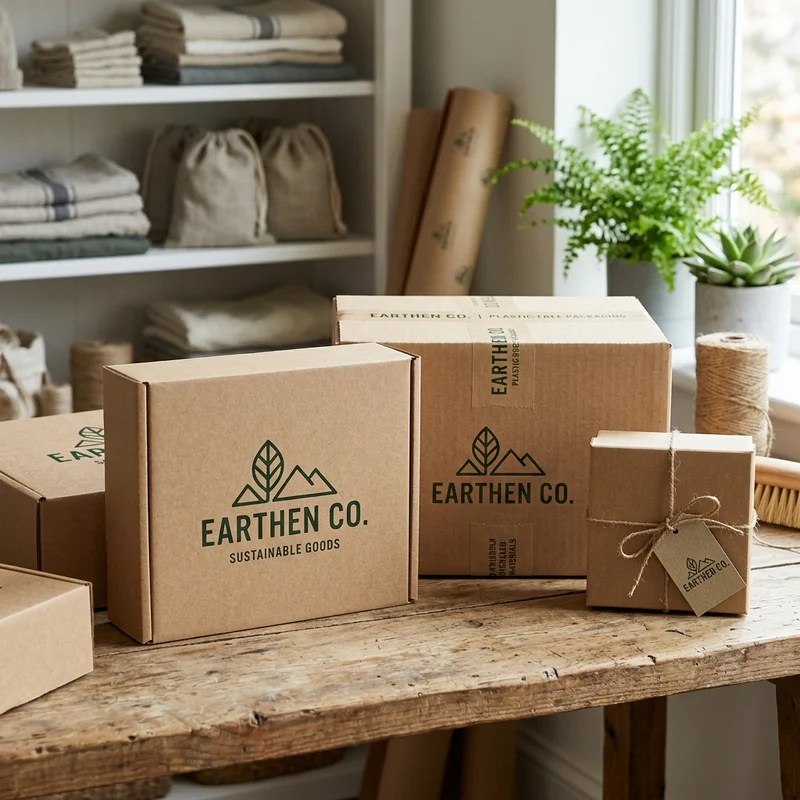
There is no fixed size for an eco-friendly box. Each one is cut to fit your product. It ships safely with the least stock and no waste. Right-sizing is the biggest green win most brands miss. A snug box cuts board use. It drops void fill. And it lowers the weight you pay to ship. These are popular starting sizes, each fully customizable:
| Use Case | Popular Size (L × W × H) | Best Eco Material |
|---|---|---|
| Small product box | 4.0 × 4.0 × 4.0 in | Recycled kraft paperboard |
| Kraft tuck-end box | 5.0 × 3.0 × 7.0 in | FSC-certified kraft |
| Eco mailer box | 8.0 × 6.0 × 2.0 in | Recycled E-flute corrugated |
| Shipping / RSC box | 10.0 × 8.0 × 6.0 in | Recycled B-flute corrugated |
| Subscription box | 12.0 × 9.0 × 4.0 in | Recycled kraft corrugated |
Printing and Eco Finishes
Recycled and kraft stocks print well when you design for them. Use offset or digital print with soy or water inks. Match brand color with CMYK or Pantone. On kraft, colors read a bit warmer and softer than on white stock. That is part of the eco look. Full-bleed print wraps art across the whole box. It gives a rich feel even on bare board. For finishes, pick matte coats, embossing, or debossing. Skip plastic and foil so the box can still be recycled.
Eco-Friendly Boxes for Every Industry
Green packs fit almost every line, from one SKU to a full range. Brands across the United States use eco-friendly boxes for:
- Beauty and personal care — kraft soap boxes, skincare cartons, and bath sets. Natural stock backs up a clean story.
- Food and drink — compostable, food-safe takeout, bakery, and deli packs that meet the rules.
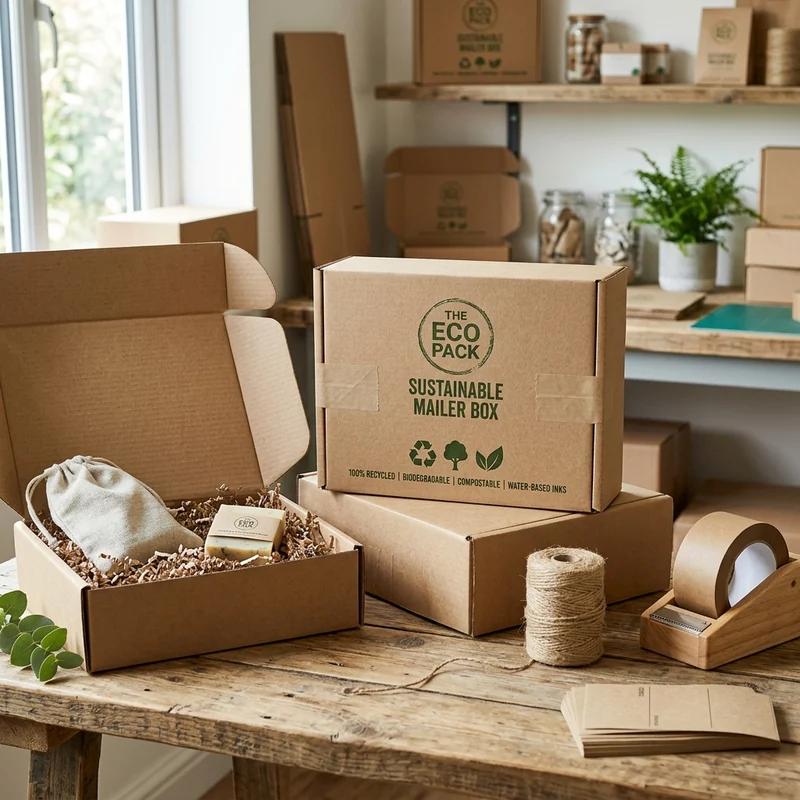
- E-commerce — recycled mailer boxes and corrugated shippers that keep the whole unboxing green.
- Retail and monthly — recycled shelf and kit packs built for a strong on-brand reveal.
- Supplements and home goods — recycled board cartons for daily items that need a clean look.
Whatever you sell, there is almost always a paper version of your current box. It keeps the same shape and shelf look.
Certifications and Avoiding Greenwashing
A green claim only helps if it holds up. Vague words like "eco" or "all natural" with nothing behind them break trust. In some states they can draw rule-maker heat. Keep claims clear and easy to prove. Name the stock ("100% recycled kraft"). Name the action ("takes to curbside bins"). Or name the mark (FSC, or a known compost mark). If a finish breaks recycling, say so. Do not imply the whole box can be recycled. Clear, honest claims win with shoppers who pay attention. Broad green talk does not.
Wholesale Custom Eco-Friendly Boxes: Cost and Minimums
Going green should not mean paying more. We make the boxes ourselves. So our wholesale eco-friendly boxes carry no plate, setup, or die fees. Recycled stocks cost about the same as normal board. Low minimums let you test a green design before scaling. Free design and dielines remove upfront cost. Right-sizing trims both stock and freight. Standard turnaround is 10–12 work days, with rush options in 6–8. Every order ships free across the USA.
How to Order Custom Eco-Friendly Boxes
- Request a free quote — share your box style, size, quantity, and preferred eco material, or just send the product.
- Get a free dieline and proof — our designers prepare print-ready artwork and a digital proof at no cost.
- Approve and we print — once you sign off, we make factory-direct on recyclable stock.
- Free delivery — your finished eco-friendly boxes ship to your door across the United States.
Want to feel the quality first? Compare recycled stocks and kraft grades in hand before you commit by requesting samples with your quote.
Final Thoughts
Green packing works best when the green choice is also the tight choice. Pick a paper board that can be recycled. Right-size the box to cut waste. Keep finishes recyclable. Make claims you can prove. Do that and an eco-friendly box guards the product, cuts cost, and wins trust at the same time. When you are ready, we will help you choose the material and build the dieline at no cost.
Explore More
Ready to put this into action? Explore our Custom Eco-Friendly Boxes range — including Recyclable Packaging Boxes and Wholesale Kraft Boxes — and read our custom corrugated boxes guide for recycled shipping options. For ongoing packaging industry news and sustainability trends, Packaging World is a trusted U.S. source.
Frequently Asked Questions
What are eco-friendly boxes made of?
Most custom eco-friendly boxes are made from recyclable, recycled-content, or plant-based fiber — typically recycled kraft, recycled paperboard, FSC-certified board, or recycled corrugated. They are printed with soy- or water-based inks and avoid plastic film windows and foil laminates that are hard to recycle.
Are recyclable and biodegradable the same thing?
No. Recyclable means the material can be collected and reprocessed into new products, and clean kraft and corrugated are widely recycled curbside in the U.S. Biodegradable only means a material breaks down over time, with no set timeframe or conditions, so it is the weakest claim. Compostable is a stricter, usually certified claim that breaks down into non-toxic matter under defined composting conditions.
Do eco-friendly boxes cost more than regular boxes?
Not significantly. Because we make factory-direct with no plate or setup fees, recycled stocks are priced about the same as normal board. Right-sizing a sustainable box often lowers material and shipping cost, so the greener box can also be the cheaper box.
Can you print full color on recycled or kraft stock?
Yes. Recycled and kraft stocks print well with offset or digital printing and CMYK or Pantone color matching. On natural kraft, colors read a little warmer and softer than on white stock, which is part of the eco look; full-bleed printing is available across the whole box.
What is the minimum order for custom eco-friendly boxes?
Minimums are low so you can test a sustainable design before scaling. Share your style, size, and quantity for an exact quote, with free design and dielines included and free delivery across the USA.
Are eco-friendly boxes food-safe?
Yes, when specified for food contact. We offer food-safe and compostable options for takeout, bakery, and deli packaging that meet contact requirements. Tell us the product and we will recommend the right certified material and any liner or coating needed.
What price can I expect for custom eco-friendly boxes in bulk?
Wholesale custom eco-friendly boxes start from about $0.10 per unit at Discount Box Printing, with the final price set by size, board thickness, print color count, and run size. Larger orders cut the per-unit cost by a wide margin, and you can send a competing quote to our <a href="/beat-my-quote">Beat My Quote</a> page to lock in a better rate.
What is the minimum order quantity for custom eco-friendly boxes?
We print custom eco-friendly boxes with a low minimum order so small brands and new product lines can start without a big spend. Low MOQs let you test art and sizes on the shelf before you scale up, and when you reorder in bulk the per-unit price drops. Reach out for the exact MOQ on your spec.
How long does it take to print and deliver custom eco-friendly boxes?
Standard turnaround on custom eco-friendly boxes is about 10 to 12 business days after proof approval, with a 6 to 8 day rush option on most jobs. Timing starts once art and dieline are signed off, so a fast proof reply keeps the clock short. Free US ground shipping is included on every order.
Do you offer free design, a dieline, and a 3D mockup for custom eco-friendly boxes?
Yes. Every custom eco-friendly boxes order at Discount Box Printing includes free design help, a print-ready dieline, and a 3D mockup before we go to press. Our team cleans up logos, sets bleeds, and checks food-safe inks when needed, so the box you approve on screen is the box you receive at your door.
Do you ship custom eco-friendly boxes across the United States?
Yes. We make custom eco-friendly boxes factory-direct and ship to every state in the US with free ground freight on wholesale orders. Our team at Discount Box Printing coordinates print, cut, and dispatch under one roof, so your boxes land on time whether you order from New York, Texas, California, or anywhere between.
Ready to order your custom boxes?
Free design, low minimums, fast turnaround — at wholesale prices.
Get a Free QuoteRelated Packaging
Products and categories mentioned in this article.
Eco-Friendly Boxes
Custom Soap Boxes
Custom Corrugated Boxes
Recyclable Packaging Boxes
Plastic Free Packaging Boxes
Related Posts
Eco-Friendly Gift Box Packaging Options for Brands
Eco-Friendly Mailer Box Options for Online Sellers